
When your car doesn’t start, it can be super frustrating. One of the first things people think is, “Is the battery dead?”
But sometimes, the battery isn’t really dead—it just needs a charge. So how can you tell the difference? This guide will help you figure it out step by step.
Let’s break it down in simple terms so you can spot the signs and take action.
1. Look for the Warning Signs
Your car gives you clues when something’s wrong. Pay attention to how it acts when you try to start it.
- Slow engine crank: When the engine turns over slowly and struggles to start, your battery might be low—not completely dead. It may just need a boost or charge.
- Clicking sound: If you hear a fast clicking noise when you turn the key or press the start button, it means the battery doesn’t have enough power to turn on the engine. It’s weak, but not necessarily dead yet.
- No noise, no lights: If you turn the key and hear nothing, and your lights don’t come on either, the battery might be fully drained—or it could be dead beyond saving.
- Lights on, engine off: If the dashboard lights or radio turn on, but the engine doesn’t start, it could be a weak battery—or something else like a bad starter or fuel issue.
By noticing these signs, you’ll know whether your battery is completely gone or just needs a bit of charging.
2. Check the Lights and Electronics
Your car’s lights and electronics run on battery power, so they can give clues about the battery’s condition.
- Bright headlights: If your headlights come on and are bright, the battery still has power. It might not be the issue.
- Dim or flickering lights: If your headlights are weak or blink on and off, your battery likely needs charging.
- No lights at all: If you turn the key and see nothing—not even a dome light—the battery might be completely drained or disconnected.
Try the radio, windshield wipers, and power windows too. If none of those work, your battery may be very low or dead.
3. Try Jumpstarting the Car
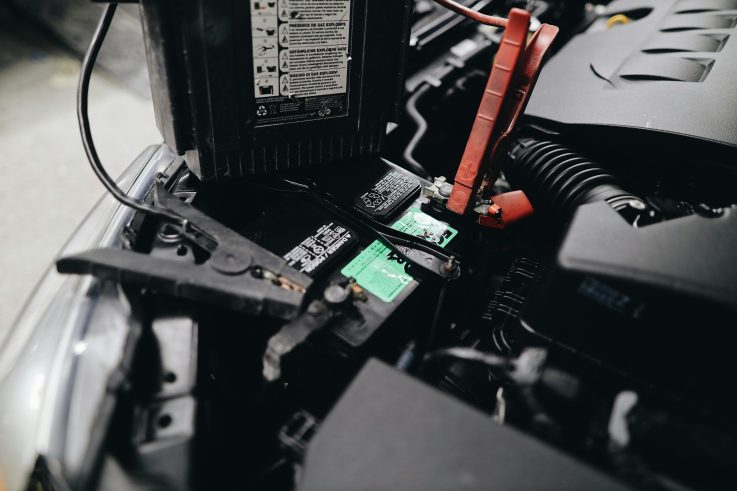
Jumpstarting is a great way to test the battery. All you need is a set of jumper cables and another vehicle with a good battery.
Here’s how to do it safely:
- Park both cars close together, but not touching.
- Turn off both engines.
- Connect the red cable to the positive terminal on the dead battery.
- Connect the other end of the red cable to the positive terminal on the good battery.
- Connect the black cable to the negative terminal on the good battery.
- Connect the last black clamp to a clean, unpainted metal surface on the dead car (not the battery).
- Start the car with the good battery.
- Wait 2-3 minutes, then try starting the dead car.
Results:
- If your car starts and keeps running, the battery was just low.
- If your car starts but dies again shortly, your battery may not hold a charge.
- If it doesn’t start at all, your battery could be dead or there may be another issue.
Jumpstarting is a quick and useful way to learn what kind of shape your battery is in.
4. Check the Battery Voltage (If You Have a Multimeter)
A multimeter is a small tool that measures voltage. You can get one at most auto parts stores or online. It gives an exact number to show how charged your battery is.
Steps:
- Turn off your car.
- Set the multimeter to DC voltage (20V range).
- Connect the red probe to the positive terminal.
- Connect the black probe to the negative terminal.
- Read the number on the screen.
What the numbers mean:
- 12.6 volts or higher – The battery is fully charged.
- 12.4–12.5 volts – The battery is fine but could use a top-off.
- 12.0–12.3 volts – The battery is low; recharge it
- 11.8 volts or lower – Battery is very low or possibly dead.
This method helps you decide whether to recharge, replace, or test further.
5. Inspect the Battery for Damage
Sometimes you don’t need tools—just your eyes. A damaged battery can’t work properly and may even be dangerous.
Look for:
- Corrosion on terminals: White or green buildup on the metal posts.
- Cracks or bulges: If the battery looks swollen or has cracks, replace it immediately.
- Leaking fluid: This is dangerous. Acid leaks mean the battery is done.
- Rotten egg smell: This sulfur smell means the battery is leaking gas—get it checked out fast.
If your battery shows any of these signs, don’t try to charge it. It’s time to get a new one.
6. Watch for Repeated Problems
If you keep having to jump your car every few days, your battery isn’t reliable anymore. Even if it starts fine right after charging, a healthy battery should hold power for a while.
Ask yourself:
- Has this battery been in the car for more than 3–5 years?
- Am I constantly needing jumpstarts?
- Does the car act weird after it sits overnight?
If the answer is yes to any of these, your battery might be at the end of its life. It may be time to replace it before it leaves you stranded.
7. Charge It Fully and See What Happens
If you have a battery charger, try charging your battery overnight.
After charging:
- If your car starts and works fine for several days, the battery was just low.
- If your car struggles to start again soon, the battery isn’t holding a charge—it’s probably dead.
Charging gives you a chance to see how well the battery performs without guessing.
8. Get a Free Battery Test at a Store
Many auto parts stores will test your battery for free. This is a great option if you’re not sure what’s wrong. They’ll check:
- Voltage level
- Charge capacity
- Cold-cranking amps (how well the battery performs in cold weather)
Places like AutoZone, O’Reilly, or Advance Auto Parts offer this service. It’s quick and saves you money and time.
9. Don’t Forget the Alternator
Sometimes the battery isn’t the problem at all. Your alternator charges the battery while the car is running. If it’s not working, the battery can drain—even if it’s brand new.
Signs of alternator trouble:
- Headlights dim while driving
- Dashboard battery warning light
- Strange noises or burning smell
- Car shuts off while driving
If your battery dies repeatedly, ask a mechanic to test the alternator too.
Final Thoughts
When your car won’t start, it’s easy to think the battery is dead—but that’s not always the case. Use the steps above to figure out what’s really going on.
From checking lights and jumpstarting to using a multimeter or getting a free test at a store, there are plenty of simple ways to find out the truth.
A dead battery needs to be replaced. But if it just needs a charge, now you know exactly what to do.
Stay safe, stay prepared—and don’t let a weak battery catch you off guard!

